Offworld Voyage focuses on the development of ecologically sustainable space analog research facilities intended for use in live immersive simulation missions that solve for interplanetary exploration as well as adaptation to the extremes of a rapidly changing biosphere on Earth.
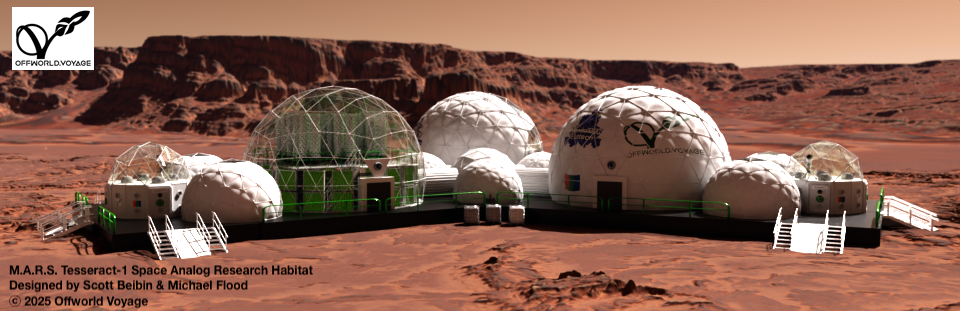
M.A.R.S. Tesseract-1 is a space analog research training habitat currently in development, designed for use in Mars surface analog simulations – consisting of modular interconnected living structures.
Planned Space Analog Research activities include:
- On site cultivation of nutrient dense plant based / vegan foods
- EVAs utilizing sim-spacesuits embedded with biosensors
- Development of open source decentralized communications and coordination tools and protocols
- Mission Support / Mission Control training
- Geological analysis and mapping
- Off-grid and autonomous power production
- Exercises in extreme reduction of resource consumption
- Coordinated decision making and collective action
- Water purification and re-use
- Composting and re-processing of organic waste
- Creative on-site repair and recycling of all materials
The inaugural mission for the Tesseract-1 habitat is currently being planned to occur in an isolated and remote desert location in 2027.
The project is co-founded by Mars Desert Research Station alumni Scott Beibin and Elizabeth Jane Cole.